Friday, October 28, 2011

Low-cost paper-based wireless sensor could help detect explosive devices

Low-cost paper-based wireless sensor could help detect explosive devices [ Back to EurekAlert! ] Public release date: 26-Oct-2011
[ | E-mail | Share Share ]

Contact: John Toon
jtoon@gatech.edu
404-894-6986
Georgia Institute of Technology Research News

Researchers at the Georgia Institute of Technology have developed a prototype wireless sensor capable of detecting trace amounts of a key ingredient found in many explosives.

The device, which employs carbon nanotubes and is printed on paper or paper-like material using standard inkjet technology, could be deployed in large numbers to alert authorities to the presence of explosives, such as improvised explosive devices (IEDs).

"This prototype represents a significant step toward producing an integrated wireless system for explosives detection," said Krishna Naishadham, a principal research scientist who is leading the work at the Georgia Tech Research Institute (GTRI). "It incorporates a sensor and a communications device in a small, low-cost package that could operate almost anywhere."

Other types of hazardous gas sensors are based on expensive semiconductor fabrication and gas chromatography, Naishadham said, and they consume more power, require human intervention, and typically do not operate at ambient temperatures. Furthermore, those sensors have not been integrated with communication devices such as antennas.

The wireless component for communicating the sensor information -- a resonant lightweight antenna was printed on photographic paper using inkjet techniques devised by Professor Manos Tentzeris of Georgia Tech's School of Electrical and Computer Engineering. Tentzeris is collaborating with Naishadham on development of the sensing device.

The sensing component, based on functionalized carbon nanotubes (CNTs), has been fabricated and tested for detection sensitivity by Xiaojuan (Judy) Song, a GTRI research scientist. The device relies on carbon-nanotube materials optimized by Song.

A presentation on this sensing technology was given in July at the IEEE Antennas and Propagation Symposium (IEEE APS) in Spokane, Wash., by Hoseon Lee, a Ph.D. student in ECE co-advised by Tentzeris and Naishadham. The paper received the Honorable Mention Award in the Best Student Paper competition at the symposium.

This is not the first inkjet-printed ammonia sensor that has been integrated with an antenna on paper, said Tentzeris. His group produced a similar integrated sensor last year in collaboration with the research group of C.P. Wong, who is Regents professor and Smithgall Institute Endowed Chair in the School of Materials Science and Engineering at Georgia Tech.

"The fundamental difference is that this newest CNT sensor possesses dramatically improved sensitivity to miniscule ammonia concentrations," Tentzeris said. "That should enable the first practical applications to detect trace amounts of hazardous gases in challenging operational environments using inkjet-printed devices."

Tentzeris explained that the key to printing components, circuits and antennas lies in novel "inks" that contain silver nanoparticles in an emulsion that can be deposited by the printer at low temperatures around 100 degrees Celsius. A process called sonication helps to achieve optimal ink viscosity and homogeneity, enabling uniform material deposition and permitting maximum operating effectiveness for paper-based components.

"Ink-jet printing is low-cost and convenient compared to other technologies such as wet etching," Tentzeris said. "Using the proper inks, a printer can be used almost anywhere to produce custom circuits and components, replacing traditional clean-room approaches."

Low-cost materials such as heavy photographic paper or plastics like polyethylene terephthalate -- can be made water resistant to ensure greater reliability, he added. Inkjet component printing can also use flexible organic materials, such as liquid crystal polymer (LCP), which are known for their robustness and weather resistance. The resulting components are similar in size to conventional components but can conform and adhere to almost any surface.

Naishadham explained that the same inkjet techniques used to produce RF components, circuits and antennas can also be used to deposit the functionalized carbon nanotubes used for sensing. These nanoscale cylindrical structures -- about one-billionth of a meter in diameter, or 1/50,000th the width of a human hair -- are functionalized by coating them with a conductive polymer that attracts ammonia, a major ingredient found in many IEDs.

Sonication of the functionalized carbon nanotubes produces a uniform water-based ink that can be printed side-by-side with RF components and antennas to produce a compact wireless sensor node.

"The optimized carbon nanotubes are applied as a sensing film, with specific functionalization designed for a particular gas or analyte," Song said. "The GTRI sensor detects trace amounts of ammonia usually found near explosive devices, and it can also be designed to detect similar gases in household, healthcare and industrial environments at very low concentration levels."

The sensor has been designed to detect ammonia in trace amounts as low as five parts per million, Naishadham said.

The resulting integrated sensing package can potentially detect the presence of trace explosive materials at a distance, without endangering human lives. This approach, called standoff detection, involves the use of RF technology to identify explosive materials at a relatively safe distance. The GTRI team has designed the device to send an alert to nearby personnel when it detects ammonia.

The wireless sensor nodes require relatively low power, which could come from a number of technologies including thin-film batteries, solar cells or power-scavenging and energy-harvesting techniques. In collaboration with Tentzeris's and Wong's groups, GTRI is investigating ways to make the sensor operate passively, without any power consumption.

"We are focusing on providing standoff detection for those engaged in military or humanitarian missions and other hazardous situations," Naishadham said. "We believe that it will be possible, and cost-effective, to deploy large numbers of these detectors on vehicles or robots throughout a military engagement zone."

###


[ Back to EurekAlert! ] [ | E-mail | Share Share ]

?


AAAS and EurekAlert! are not responsible for the accuracy of news releases posted to EurekAlert! by contributing institutions or for the use of any information through the EurekAlert! system.


Low-cost paper-based wireless sensor could help detect explosive devices [ Back to EurekAlert! ] Public release date: 26-Oct-2011
[ | E-mail | Share Share ]

Contact: John Toon
jtoon@gatech.edu
404-894-6986
Georgia Institute of Technology Research News

Researchers at the Georgia Institute of Technology have developed a prototype wireless sensor capable of detecting trace amounts of a key ingredient found in many explosives.

The device, which employs carbon nanotubes and is printed on paper or paper-like material using standard inkjet technology, could be deployed in large numbers to alert authorities to the presence of explosives, such as improvised explosive devices (IEDs).

"This prototype represents a significant step toward producing an integrated wireless system for explosives detection," said Krishna Naishadham, a principal research scientist who is leading the work at the Georgia Tech Research Institute (GTRI). "It incorporates a sensor and a communications device in a small, low-cost package that could operate almost anywhere."

Other types of hazardous gas sensors are based on expensive semiconductor fabrication and gas chromatography, Naishadham said, and they consume more power, require human intervention, and typically do not operate at ambient temperatures. Furthermore, those sensors have not been integrated with communication devices such as antennas.

The wireless component for communicating the sensor information -- a resonant lightweight antenna was printed on photographic paper using inkjet techniques devised by Professor Manos Tentzeris of Georgia Tech's School of Electrical and Computer Engineering. Tentzeris is collaborating with Naishadham on development of the sensing device.

The sensing component, based on functionalized carbon nanotubes (CNTs), has been fabricated and tested for detection sensitivity by Xiaojuan (Judy) Song, a GTRI research scientist. The device relies on carbon-nanotube materials optimized by Song.

A presentation on this sensing technology was given in July at the IEEE Antennas and Propagation Symposium (IEEE APS) in Spokane, Wash., by Hoseon Lee, a Ph.D. student in ECE co-advised by Tentzeris and Naishadham. The paper received the Honorable Mention Award in the Best Student Paper competition at the symposium.

This is not the first inkjet-printed ammonia sensor that has been integrated with an antenna on paper, said Tentzeris. His group produced a similar integrated sensor last year in collaboration with the research group of C.P. Wong, who is Regents professor and Smithgall Institute Endowed Chair in the School of Materials Science and Engineering at Georgia Tech.

"The fundamental difference is that this newest CNT sensor possesses dramatically improved sensitivity to miniscule ammonia concentrations," Tentzeris said. "That should enable the first practical applications to detect trace amounts of hazardous gases in challenging operational environments using inkjet-printed devices."

Tentzeris explained that the key to printing components, circuits and antennas lies in novel "inks" that contain silver nanoparticles in an emulsion that can be deposited by the printer at low temperatures around 100 degrees Celsius. A process called sonication helps to achieve optimal ink viscosity and homogeneity, enabling uniform material deposition and permitting maximum operating effectiveness for paper-based components.

"Ink-jet printing is low-cost and convenient compared to other technologies such as wet etching," Tentzeris said. "Using the proper inks, a printer can be used almost anywhere to produce custom circuits and components, replacing traditional clean-room approaches."

Low-cost materials such as heavy photographic paper or plastics like polyethylene terephthalate -- can be made water resistant to ensure greater reliability, he added. Inkjet component printing can also use flexible organic materials, such as liquid crystal polymer (LCP), which are known for their robustness and weather resistance. The resulting components are similar in size to conventional components but can conform and adhere to almost any surface.

Naishadham explained that the same inkjet techniques used to produce RF components, circuits and antennas can also be used to deposit the functionalized carbon nanotubes used for sensing. These nanoscale cylindrical structures -- about one-billionth of a meter in diameter, or 1/50,000th the width of a human hair -- are functionalized by coating them with a conductive polymer that attracts ammonia, a major ingredient found in many IEDs.

Sonication of the functionalized carbon nanotubes produces a uniform water-based ink that can be printed side-by-side with RF components and antennas to produce a compact wireless sensor node.

"The optimized carbon nanotubes are applied as a sensing film, with specific functionalization designed for a particular gas or analyte," Song said. "The GTRI sensor detects trace amounts of ammonia usually found near explosive devices, and it can also be designed to detect similar gases in household, healthcare and industrial environments at very low concentration levels."

The sensor has been designed to detect ammonia in trace amounts as low as five parts per million, Naishadham said.

The resulting integrated sensing package can potentially detect the presence of trace explosive materials at a distance, without endangering human lives. This approach, called standoff detection, involves the use of RF technology to identify explosive materials at a relatively safe distance. The GTRI team has designed the device to send an alert to nearby personnel when it detects ammonia.

The wireless sensor nodes require relatively low power, which could come from a number of technologies including thin-film batteries, solar cells or power-scavenging and energy-harvesting techniques. In collaboration with Tentzeris's and Wong's groups, GTRI is investigating ways to make the sensor operate passively, without any power consumption.

"We are focusing on providing standoff detection for those engaged in military or humanitarian missions and other hazardous situations," Naishadham said. "We believe that it will be possible, and cost-effective, to deploy large numbers of these detectors on vehicles or robots throughout a military engagement zone."

###


[ Back to EurekAlert! ] [ | E-mail | Share Share ]

?


AAAS and EurekAlert! are not responsible for the accuracy of news releases posted to EurekAlert! by contributing institutions or for the use of any information through the EurekAlert! system.


Source: http://www.eurekalert.org/pub_releases/2011-10/giot-lpw102611.php

man up wayne newton naomi wolf ron paul 2012 mitt romney newt gingrich columbus dispatch

Thursday, October 27, 2011

Kelly Clarkson as strong as ever on new album (Reuters)

NEW YORK (Reuters) ? Kelly Clarkson is concerned. She released her new album "Stronger" this week and thinks it is her best work yet, but whenever something like that happens she worries nobody will like it.

The 13-song collection finds Clarkson working with a handful of new songwriters on some tunes and continuing to write her own music, which she has done since winning TV singing contest "American Idol" in 2002 at age 20.

While many past "Idol" winners have failed to rise to the heights of superstardom, Clarkson has enjoyed chart-topping success with pop rock singles such as "Miss Independent" and the smash hit, "Since U Been Gone."

But at age 29, the Texas native now has seen both highs and lows in her career, and she knows that even if she thinks her songs are great, the fans are the ultimate decision makers.

"Whenever you love something so much -- and I think this is my best yet -- I think sometimes when I think like that, it means no one's going to like it," she said of "Stronger."

A majority of the songs on the new album find Clarkson at an emotionally charged state. The sound straddles the line between big dance numbers and arena-rock bombast, which has become her signature calling card.

Clarkson calls the album "very intense" and said she felt she had a lot of energy and "soulfulness" to put into it. She likened each song to its "own little rollercoaster ride. Dynamically, vocally, that's what I love doing."

The energy is evident on the first single, "Mr. Know It All," as well as the up-and-down rock moments of "You Can't Win" and the electro-rock arrangements of "Let Me Down."

SONGS ABOUT REAL LIFE

Lyrically, the songs dwell heavily on relationships and empowerment, two subjects that have been highlights her work through the years.

"I love writing and singing songs about real life situations -- especially about relationships," she said. "Everyone wants to feel like they're not alone in a thought. That's the best feeling I get, when I hear a song and it's like 'you just nailed me.' That's the coolest thing in the world, to write something that can be relatable to other human beings."

Over the years, Clarkson's image has been that of an artist who is willing to speak her mind in regards to her creative output, even if it meant going against her label, as she did surrounding 2007's "My December."

And as she has matured, making music seems to be getting easier for Clarkson, mainly because she has not clung too closely to any one genre. In recent years, she's collaborated with country stars Reba McEntire, Rascal Flatts and Martina McBride. She also co-headlined a tour with McEntire in 2008.

"Stronger" continues to reflect her expanded range in musical styles, as evidenced by the dance-pop of "What Doesn't Kill You (Stronger)," charged rock and roll of "Hello" and the power ballad "Standing in Front of You."

Yet, while she may continue to explore different sounds and arrangements throughout her career, her vocals on "Stronger" remain her biggest asset among fans and critics.

In its review for "Stronger," The New York Times described Clarkson as turning into the "Mary J. Blige of pop music," where she's becoming "so good at being wounded that no one wants her to heal."

The Washington Post was less than thrilled, however, calling the album "comforting" but "unchallenging."

(Editing by Bob Tourtellotte)

Source: http://us.rd.yahoo.com/dailynews/rss/celebrity/*http%3A//news.yahoo.com/s/nm/20111025/music_nm/us_kellyclarkson

tough love patriots jets patriots jets wes welker the music man the music man new england patriots

"We Need to Talk About Kevin" wins London film prize (Reuters)

LONDON (Reuters) ? "We Need to Talk About Kevin," an unflinching portrayal of a mother's troubled relationship with her son starring Oscar winner Tilda Swinton, won the London film festival's best picture award on Wednesday.

The movie, which impressed critics when it premiered at the Cannes film festival in May, was directed by Scottish film maker Lynne Ramsay and based on Lionel Shriver's award-winning novel of the same name.

"We Need to Talk About Kevin" was one of nine best film nominees at London's annual cinema showcase, and beat Venice winner "Faust" and "The Descendants" starring George Clooney, among others.

"In the end, we were simply bowled over by one film, a sublime, uncompromising tale of the torment that can stand in the place of love," said John Madden, chair of the judging panel. "'We Need to Talk About Kevin' is made with the kind of singular vision that links great directors across all the traditions of cinema."

The British newcomer award went to actress Candese Reid for her work in "Junkhearts," her first professional acting role.

The Sutherland Award, honoring the "most original and imaginative feature debut" at this year's festival, was won by Argentinean director Pablo Giorgelli for "Las Acacias."

And the Grierson Award for best documentary went to Werner Herzog's death-row examination "Into the Abyss: A Tale of Death, A Tale of Life."

As previously announced, Canadian director David Cronenberg and British actor Ralph Fiennes were awarded the BFI Fellowship, the British Film Institute's highest accolade.

This year's festival closes on Thursday with a gala screening of "The Deep Blue Sea," Terence Davies' adaptation of Terence Rattigan's play starring Rachel Weisz.

(Reporting by Mike Collett-White)

Source: http://us.rd.yahoo.com/dailynews/rss/movies/*http%3A//news.yahoo.com/s/nm/20111026/film_nm/us_london_award

liberace liberace repudiate avengers joost joost new hampshire debate

Summary Box: Stocks slide as Europe deal falters (AP)

EUROPE: Stocks slid after a key meeting between financial ministers scheduled for Wednesday was canceled. The abrupt notice led some investors to believe that a deal to solve Europe's debt crisis may not be as close as originally thought.

EARNINGS: Manufacturing conglomerate 3M cut its 2011 earnings forecast, and U.S. Steel warned that demand for its products could slow. Netflix Inc. plunged 35 percent after the company cut its profit forecast.

RISK OFF: Small company stocks fell far more than the broader market, a sign that investors were shunning assets perceived as being risky. The Russell 2000, an index of small companies, plunged 3 percent, reversing a gain of 3.3 percent Monday.

Source: http://us.rd.yahoo.com/dailynews/rss/stocks/*http%3A//news.yahoo.com/s/ap/20111025/ap_on_bi_ge/us_wall_street_summary_box

cole hamels cole hamels curtis painter apple news conference apple news conference apple news apple iphone

Perry wants flat tax with some popular deductions (AP)

GRAY COURT, S.C. ? Republican presidential candidate Rick Perry proposed a sweeping economic plan Tuesday that includes a flat tax proposal, private retirement accounts for Social Security, a lower corporate tax rate and reforms aimed at keeping Medicare solvent.

In a pitch to right-wing conservatives, the Texas governor outlined a proposal he calls "Cut, Balance and Grow" that he says is bolder and more aggressive than what his Republican rivals or President Barack Obama would do.

"America is under a crushing burden of debt, and the president simply offers larger deficits and the politics of class division," Perry said. "Others simply offer microwaved plans with warmed-over reforms based on current ingredients."

In his speech, Perry outlined a broad plan that would make fundamental changes to the tax code and to the nation's entitlement programs.

After weeks of calling Social Security a "Ponzi scheme," he offered five concrete principles for reforming the program. Perry said he wants to keep benefits intact for current retirees, but allow younger workers to choose to put their income into private accounts instead. He wants to allow states and local governments to opt out of the federal program and invest in different funds instead. And he wants to raise the retirement age for younger workers.

Perry also wants to make major changes to Medicare. His plan would allow Americans to receive a payment or a credit for the purchase of health insurance instead of the direct benefits provided through the current program. He would also gradually raise the Medicare eligibility age and pay people benefits based on their income levels.

Perry's plan sets a flat 20 percent income tax rate, but also gives taxpayers the option of sticking with their current rate. He would also maintain popular deductions for families making less than $500,000 a year and end taxes on Social Security benefits. Perry would end corporate loopholes and lower the general corporate tax rate to 20 percent.

Many elements of Perry's plan are controversial ? and others have tried and failed to pass them. President George W. Bush tried to add private accounts to Social Security, but the proposal was widely condemned and did not pass.

"I am not naive. I know this idea will be attacked," Perry said of the proposal. "Opposition to this simple measure is based on a simple supposition: that the people are not smart enough to look out for themselves."

President Barack Obama's campaign immediately criticized Perry's plan as hurtful to middle class Americans. Perry's plan, Obama spokesman Ben LaBolt said, "would shift a greater share of taxes away from large corporations and the wealthiest onto the backs of the middle class."

The major policy rollout is a critical part of Perry's efforts to right a struggling campaign. It's an opportunity to demonstrate a heft and seriousness that wasn't on display during recent debates.

Distracting from Perry's speech, however, were new comments he made questioning whether Obama was born in the United States, a debunked controversy that centered on Obama's birth certificate.

In an interview with CNBC, Perry said it was "fun to ? to poke" at the president on the birth certificate issue. "I don't have a clue about where the president ? and what this birth certificate says," Perry said. He was defending an interview he did with Parade magazine, when he said he did not have a "definitive answer" about whether Obama was born in the United States.

Republican strategist Karl Rove ripped Rick Perry for casting doubt on Obama's birth. "You associate yourself with a nutty view like that, and you damage yourself," Rove told Fox News.

But the comments do appeal to a segment of the Republican Party's right wing ? a group Perry is clearly trying to court. Perry's policy speech Tuesday sets him distinctly to the right of chief rival Mitt Romney, who wants to make less sweeping changes to the tax code.

The birth certificate comments and policy rollout comes as Perry prepares to air TV ads in Iowa and has hired a roster of experienced national campaign operatives to help him. Perry's chief adviser on the economic plan is former presidential candidate Steve Forbes, who proposed a 17 percent flat tax when he ran for president in 1996.

It's taken Perry about 2 1/2 months to put together an economic policy package, and he's had to attend the series of debates without his detailed proposal. Romney also has attacked him repeatedly for not having a plan. Romney released a 59-point jobs plan in early September, about three months after officially announcing his bid.

Perry's plan would make more dramatic changes than Romney's. While Perry's plan includes the flat tax, Romney would lower rates on corporations and on savings and investment income for middle-class Americans.

Back in 1996, Romney criticized Forbes' flat tax plan as a "tax cut for fat cats." In the CNBC interview, Perry said if Romney renews that criticism, "he ought to look in the mirror, I guess. I consider him to be a fat cat."

Perry chose South Carolina, where he announced he was running for president, to unveil his economic plan. The first-in-the-South primary state is critical to his path to the nomination, though he has fallen in the polls here just as he has dropped nationally.

He also planned a news conference in the state capital, Columbia, and a fundraiser at the home of former South Carolina GOP chairman Katon Dawson, his top South Carolina adviser.

Source: http://us.rd.yahoo.com/dailynews/rss/politics/*http%3A//news.yahoo.com/s/ap/20111025/ap_on_el_pr/us_perry_economy

naacp cheryl cole x factor forgetting sarah marshall freetown freetown nicole scherzinger modern family

Wednesday, October 26, 2011

Sprint posts smallest quarterly loss in 4 years

A Samsung Galaxy Tab tablet is displayed at the Sprint store in Stoneham, Mass., Tuesday, Oct. 25, 2011. Sprint is reporting its smallest quarterly loss in four years, as it's continuing a turnaround and getting better at keeping and attracting customers. (AP Photo/Charles Krupa)

A Samsung Galaxy Tab tablet is displayed at the Sprint store in Stoneham, Mass., Tuesday, Oct. 25, 2011. Sprint is reporting its smallest quarterly loss in four years, as it's continuing a turnaround and getting better at keeping and attracting customers. (AP Photo/Charles Krupa)

An HTC Evo Shift smartphone is displayed at the Sprint store in Stoneham, Mass., Tuesday, Oct. 25, 2011. Sprint is reporting its smallest quarterly loss in four years, as it's continuing a turnaround and getting better at keeping and attracting customers. (AP Photo/Charles Krupa)

(AP) ? Sprint Nextel Corp. on Wednesday reported its smallest quarterly loss in four years, as it continued a turnaround and kept getting better at keeping and attracting customers.

Sprint also provided important updates on the iPhone, its financing needs and planned network upgrades, undoing some of the damage caused by an investor day presentation three weeks ago that had investors fuming and sent its stock plunging.

Its stock edged lower Wednesday as investors continued to focus on finances that look precarious for the next two years.

The country's No. 3 wireless carrier said it added a net 1.3 million subscribers in the July to September period, the best result since 2006. Sprint continued to lose subscribers from its lucrative contract-based plans, but at a relatively low rate: 44,000 in the quarter.

Sprint's total customer count, 53.4 million, is now back at where it was in 2007, before the exodus of Nextel customers turned into a torrent.

The Overland Park, Kan.-based company has made steady gains in the last year and a half. Unfortunately for the company, most of the new customers are low-paying ones. They buy service from Sprint's low-cost Virgin Mobile, Boost Mobile or Assurance Wireless brands, or from non-Sprint brands that use the company's network.

The latest subscriber results don't include the effect of the iPhone, which Sprint started selling Oct. 14. The phone is expected to further improve the carrier's ability to keep customers, but at a high price. Apple charges about $600 for a phone that Sprint sells for $200.

Chief Financial Officer Joe Euteneuer said each iPhone will cost the company about $200 more than another smartphone. All the same, the company expects its four-year purchasing agreement with Apple to add $7 billion to $8 billion to its own bottom line.

CEO Dan Hesse compared getting the iPhone to signing a star baseball player to the "Sprint team."

"He has an expensive contract, but he's worth every penny," said Hesse, who often draws on sports analogies.

The problem for Sprint is that the cost of selling the iPhone comes up front, while the benefits, like higher service fees and lower service costs, accrue over time. Sprint doesn't expect the iPhone to be a moneymaker until 2014.

The added cost of the iPhone comes as Sprint is also starting to revamp its network for higher speeds. That adds up to financing needs of $5 billion to $7 billion in the next few years, Euteneuer said.

Sprint hopes to cover the gap by refinancing $4 billion debt coming due, Hesse said. The remaining $1 billion to $3 billion could be raised in the form of financing from the companies Sprint buying its new network equipment from: Samsung Electronics Co., Alcatel-Lucent and LM Ericsson AB.

Euteneuer said the terms of the deal with Apple are confidential, but said there's a minimum commitment to buy $15.5 billion in iPhones over four years. That works out to about 25 million phones, a figure in line with a report in The Wall Street Journal early this month that the company had committed to buying 30 million iPhones over four years.

Figures on the effect of the iPhone on Sprint's finances were missing from the presentation on Oct. 7, contributing to investor consternation. On Wednesday, Euteneuer apologized for not providing more information then.

Also Wednesday, Sprint said it had raised the limit on its credit line by $150 million and amended the terms so that an increase in the total amount of phone discounts doesn't affect its creditworthiness. It said it had $1 billion undrawn on the line.

Sprint's net loss was $301 million, or 10 cents per share, for the third quarter. That's down from $911 million, or 28 cents per share, a year ago. It was the best performance by Sprint since it reported a profit of $64 million in the third quarter of 2007.

Revenue rose 2.2 percent to $8.3 billion.

Analysts polled by FactSet expected a loss of 22 cents per share on $8.4 billion in revenue.

Sprint shares slipped 25 cents, or 9.3 percent, to $2.45 in midday trading. Two weeks ago, they hit a three-year low of $2.10.

Hesse also said the company has started discussions with Clearwire Corp. on how to make Sprint phones compatible with Clearwire's planned new wireless data network, and a discussions on commercial arrangements are ongoing. That sent Clearwire shares up 41 cents, or 25 percent, to $2.05 in pre-market trading.

Sprint owns 54 percent of Clearwire and uses its current data network for "Sprint 4G" service. But it doesn't control Clearwire's board, and the relationship between the two management teams has been cool.

Earlier this month, Sprint said it would stop selling phones compatible with Clearwire's current data network at the end of next year, with no mention of plans to use the planned "LTE" or "Long-Term Evolution" network. That sent Clearwire shares into a dive.

Sanford Bernstein analyst Craig Moffett said Sprint third-quarter results were "fairly good." If the company can straighten out its network strategy and its Clearwire relationship, investors might start to look past the financing needs of the next two years and toward the benefits that should kick in in 2014, he said.

"For the first time in a year, expectations are appropriately low, and there are now at least a few glimmers of hope," Moffett said.

Associated Press

Source: http://hosted2.ap.org/APDEFAULT/495d344a0d10421e9baa8ee77029cfbd/Article_2011-10-26-US-Earns-Sprint-Nextel/id-1947233d254a4cdb9a8cc243437bd764

neal schon neal schon eli manning eli manning new york giants cbs richard pryor

Spotted: Jessica Simpson, Unconfirmed Baby Bump


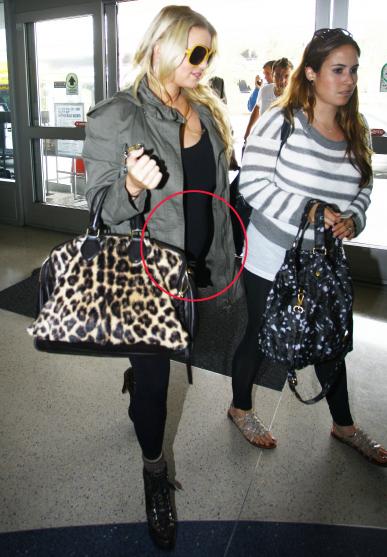
If Jessica Simpson is trying to hide the fact that she's pregnant, she needs to try harder. She showed off what appears to be a very prominent baby bump Sunday.

Reports that Jessica is pregnant with her fiancé Eric Johnson's child have not been commented on by the former singer/actress, despite lingering for weeks now.

But at the airport, she had her jacket open, bump visible for all to see ...

Jessica Simpson, Baby Bump

Jessica Simpson, her future offspring and some girl at LAX.

The 30-year-old is planning to make her public baby announcement any day now and is rumored to be shopping an exclusive interview with a $500,000 asking price.

So far, there are no takers.

We can see why, seeing that Jessica Simpson isn't exactly all the rage these days and everyone already knows she's pregnant anyway. We'll give you $50, Jess. Deal?

[Photo: Fame Pictures]

Source: http://www.thehollywoodgossip.com/2011/10/spotted-jessica-simpson-unconfirmed-baby-bump/

eddie cibrian kim delaney kim delaney dead sea scrolls new jersey nets all my children online all my children online